Thanks to the University of Hull Alumni Fund I received support to attend the Cultural transformations conference, which focused on the evaluation of Hull City of Culture 2017. The conferenced asked What’s next? and focused on the learning points from the evaluation of Hull 2017. This may seem like a bit of a segway from my interests – but it really wasn’t! My thesis focuses on the Brynmor Jones Library, one of the venues for 2017. Culture, the art gallery and the exhibitions we hosted also emerged as themes within my data. Furthermore, I am a massive geography nerd, and the talk of culture, place, economics, and impact on something so spatially bound is fundamentally human geography.
Instead of boring you all with paragraph after paragraph of text, I’ve decided to share the raw notes from four of the sessions. These notes represent an eclectic representation of what different keynotes, speakers and presenters said, also representing the debate and questions along the way. By its very nature, what I present, how I phrase it and how I connect it together perhaps is the best representation of my thoughts.
Local Identities, City Image, and Pride
This session made me one happy geographer! I loved reflecting on the issues of image and place at the city level and how they are reflected within my own thesis at the scale of a building (the library!).
Economic Vitality, Equity, and Sustainability
It’s always hard to tie figures and finances from a series of mega-events to wider socio-economic impacts – but it was certainly interesting to see some possible correlations emerge. When looking at economic development in such a bounded space it couldn’t be anything but strongly geographically related.
Wellbeing, Social Capital, and Learning
This session beautifully made the case for the link between wellbeing and culture as well as learning and culture. In particular, I found the need to evaluate not just individual impact but the impact on groups and communities particularly important. This session also made a staunch defense of qualitative research but in particular the need for such research to expand beyond narrative alone. As someone using quite innovative methods myself, this certainly chimed with my experience.
Can Culture Bring Us Together?
This session had some great debate within it. Funnily enough, there were plenty of people suggesting culture (in some way) can bring people together, but the devil is always in the detail huh!? We could certainly say culture does build civic identities, strengthen communities and improve individual wellbeing. Phew!
Beyond this conference, I should note my significant lack of blogging is very linked to thesis progress. I need to go now and lock myself away to do some more writing. My thesis is due March and hopefully, I can get blogging back soon! I certainly feel like I need to provide some updates on my progress – but in short, it’s good!
This is an opinion piece and is unapologetically skills-y. As with everything on my blog, this piece represents my personal thoughts and is not representative of any organisation I work with.
Today I had the pleasure of attending Prodigy Learning’s CertMatters Live conference. The event was hosted at the British Library, which is always a bonus as it is one of my favourite places in London (no surprise for someone who works in a library!). If you are not familiar with Prodigy Learning, they are a leading company in the training and certification industry in the UK and Ireland. They are responsible for managing certification programmes for Microsoft, Adobe and more in the UK and Ireland.
Why is this of interest to someone working in higher education?
Excellent question. I’m going to make a rare jump into the ’employability and skills agenda’ to answer that. Businesses are looking for skilled graduates, and there is a wide base of evidence that suggests there is a HUGE skills gap in the whole labour market. While a lot of these are soft skills like critical thinking, leadership, communication and so on, there is also a dramatic shortage of those with the right technical skills. Many of these technical skills can be demonstrated through the Microsoft Technology Associate (MTA) examinations. For more practical Microsoft Office certification there is the Microsoft Office Specialist (MOS) certifcations. There is also an excellent certification for educators – the Microsoft Certified Educator (MCE).
For this blog, I’m going to focus on the certifications related to Microsoft Office Specialist. This is not to suggest any less validity in those offered for other software vendors or from the Microsoft certifications (MCE/MTA), but my interest lies in Office and it is easier to leverage examples of the benefit of MOS certifications. In short, if institutions can offer students the opportunity to gain MOS certifications, it gives students more opportunity to evidence their skills in a crowded jobs market. It makes them look less-risky to employers as there is evidence of their competency. More importantly, it gives them the chance to brush up on their skills – these certifications are not all easy to get and they will need to earn them!
I think it’s also important to acknowledge the wider context our students are working in. Many of them will graduate and work in careers that don’t yet exist – especially when we look a decade ahead. To cement this point, I’m just going to bring my notes in from the keynote from Chris Rothwell at Microsoft:
Okay – but why certification?
These technical skills can actually be difficult to evidence. This makes it very difficult for businesses to identify graduates that actually possess the skills they are looking for. Immediately the value of internationally recognised certifications must be clear.
Certifications also have the possibility of addressing another serious problem. Many students write application forms or curriculum vitae that suggest they have skills. Sadly, this is not always a reality. I am not suggesting they are intentionally deceitful. Far from it! Many are often unaware of what they don’t know about the software they are using every day. From personal experience, I have interviewed many students who claim to be ‘expert’ in Microsoft Office. On further digging with Microsoft Word for example, it turns out they’ve never come across styles, mail merges, master documents, content controls. Experts they are not.
Certification gives them the option to actually learn and practice the software to a recognised level of competency. When confident, students can take the formal exam and if they pass, they can receive certification. Simple!
Where does this fit in?
Well. There are many approaches. It can be used both within the curriculum or as an optional extra-curricular opportunity. Whatever you do, offering certification alone isn’t enough. Anyone working towards certification will need learning materials to help them towards it. This could be resources developed in-house, or the badging of existing teaching where it links to certification. There is also the option of products like Microsoft Imagine Academy, lynda.com and GMetrix.
This diagram may give you a better feeling of how this all interacts:
Now. I am personally not going to suggest these should be rammed into every programme. I don’t think it would be appropriate. I’d love to see a world where every student could have the opportunity to undertake these employability-enhancing certifications. I just don’t think it should necessarily be core or forced. Some people came to university, not for employability, but for curiosity or the love of learning itself.
Now – there are exceptions. For example, people studying certain business modules probably should be competent with Excel. In those cases, I am all for curriculum integration. There are definitely cases for this with the MTA certification too.
I am not suggesting a wholesale buy-in to the degree/graduate factory. But I want to make it clear – offering certifications does not suggest this. It is about providing students who are about to go out into the rapidly developing employment market a better chance at evidencing what they can do and gaining a job! It is also acknowleding that there may be spaces where these certifications should actually be incurriculumn because it actually represents what it is to have a degree in that subject area.
It isn’t just students…
So – I’ve focused heavily on students. I think I would be doing certifications a disservice if I suggested it was for students alone. There are huge technical skills gaps throughout the whole higher education sector. There are many professional services that would be quicker, slicker and more efficient with the right technical skills in place. I am not suggesting this is part of delivery savings, but if we use Office Software to make the business of education more efficient we can all spend more time with students. This is not a bad thing.
For this bit, I’m going to defer to my notes from Elaine Topham‘s (Grimsby Institute) session on creating super staff. Elaine had an inspiring approach to fostering lifelong learning in staff, especially professional services.
What’s the catch?
Well. Like everything good in life, certification isn’t free. Single exams can be quite expensive, but these are incredibly efficient when purchased in bulk. Compared to the cost and development of in-house solutions, I think certifications represent excellent value. It’s also important to reinforce the recognition these certifications hold with employers. They also offer digital badging through Acclaim. I’m very interested in digital badging and I put a question to the panel at the end of CertMatters Live to dig into this a bit deeper. I ask the panel them how important they feel the ‘digital badge’ aspect of certifications is. The best answer was simple:
Employers are lazy.
Digital badges are quick and easy to see and verify.
More about CertMatters Live
CertMatters Live also hosted the UK and Ireland regional Word, Excel and PowerPoint Championships, with the three winners being sent to New York to compete internationally. Exciting stuff.
Professor Shân Wareing delivered an incredibly relevant and interesting keynote today at the Association for Learning Development in Higher Education (ALDinHE) Conference. Here are my notes (in mindmap format) from this session, which include elements of the discussion and wider definitions:
Dr Liz Morrish delivered an incredibly powerful keynote today at the Association for Learning Development in Higher Education ALDinHE Conference. Here are my notes (in mindmap format) from this session:
Gordon Asher delivered a very thought-provoking session this afternoon at the Association for Learning Development in Higher Education ALDinHE Conference. Here are my notes (in mindmap format) from this session, with the caveat, that they are but a small representation of what was a VERY deep discussion.
Session mindmap:
Mind map of Gordon’s session
Broader conceptual framework:
Critical academic literacies and the association with other related concepts/frameworks.
This post forms a personal reflection of a session I attended at the Association of Learning Development in Higher Education (ALDinHE) Conference 2019.
On day one of the ALDinHE Conference, I attended the Research Funding & Scholarship of Learning Development session led by Dr Maria Kukhareva & Dr Carina Buckley. This was a really interesting, interactive session, structured around the following question:
‘What is scholarship?’
This led to a rather expansive view of scholarship, not only accounting for peer-review publications, but also wider scholarly activity such as review, conference involvement and so on. However, this led to the eventual question of:
‘What is learning development scholarship?’
This question is not as easy as it seems. Scholarly activity can be pinned down and defined. Yes – there are different interpretations, but it is easy to find something that generally applies to most people. How learning development contributes to the wider scholarship of learning and teaching in higher education is however a bigger question. There must be something distinctive about it that makes it stand out against the scholarship of language learning, education and other fields.
Boyer’s model of scholarship (1990)
What makes learning development scholarship distinctive?
The real challenge of defining the distinctiveness of learning development scholarship perhaps lies with the difficulty of defining learning development. Our practices are incredibly diverse and sometimes disparate. If practice is so varied, can the scholarship be coherent enough to be classed as distinctive? While I struggle to answer this one, I ‘feel’ there is something distinctive about learning development. This is not so distinctive as to pry away from the disciplinary foundations of education as a discipline (psychology, history, sociology and philosophy), but I believe it is distinctive enough to carve out it’s own corner in the higher education literature.
This *feeling* I have regarding the distinctiveness of learning development has roots in my practice. This is because I *feel* my practice and approach is distinctive in comparison to traditional lectureship. This is because I am supporting the development of attributes, competencies, skills, approaches and so on – just not the development of disciplinary knowledge. This does not mean I have no knowledge base and convey no knowledge, just that such knowledge is of ‘being a student’, learning, writing and so on.
So – back to the question at hand. What does make learning development distinctive. We were encouraged to approach this question creatively, and this is the model the group I was part of ended up creating:
In the above photograph, you can see some of our core ideas. One of my primary contributions was the ‘lens’, as I feel learning development has a different view and approach to scholarship than other areas. In short, it is distinctive. There IS a learning development way of looking at things, even if we can’t exactly define it. I also built the pile of rubble and labelled it as ‘What is learning development?’. I promise you that the answer to that question is under those bricks. It just isn’t uncovered yet. Interestingly, I paired ‘lens’ with ‘reflection’. I think this was to highlight the reflective nature of our practice (or at least the development of it).
We also had knowledge, philosophy, inquiry, evidence and discipline(s) also on the table. These are all ideas long associated with scholarship. Once again, we had an interesting debate about what learning development brings to the table. The one we were really unsure about was ‘Mastery’. I’m still not sure how I feel about that, and this is the reason I picked it up. I think it is perhaps better related to scholarship with ‘status’ – a term another table has picked up.
I added the term ‘validity‘, because any research and scholarship must be ‘valid’ – but I think we can take this further as it links back to the question.
What makes learning development as a distinct approach a valid contribution to the wider higher education literature?
Reflection on what learning development is
This does not answer the big question. The closest thing we have to this are the ALDinHE values:
Working alongside students to make sense of and get the most out of HE learning
Making HE inclusive through emancipatory practice, partnershipworking and collaboration
Adopting and sharing effective LD practice with the HE community
Commitment to scholarly approach and research related to LD
Critical self-reflection, on-going learning and a commitment to professional development
Beyond these values, we did have a nod to practice on our model.
On the model, you can see a precarious bridge from one table to another. To fall of this bridge is to plummet between the tables. This kinda represented the journey students are on, with each step of this bridge further and further apart. While the definition of learning development is buried on our model, one thing is clear. We exist to fight anyone who would push a student off the bridge. We exist to help them over it – not to lead them, but to give them the abilities they need to take themselves over it.
You will see this bridge is hidden behind a wall. Sometimes the way ahead is unknown. It is difficult. It is hidden. We often tear that wall down to help students see where they need to go – and enable them to get there.
I’m sat in my hotel room, using my last few minutes before the start of the ALDinHE Conference to reflect on accessibility. Part of the reason for this is the journey I went through to make a resource about accessibility accessible. It isn’t as easy as it should be…
I have a graphic design background, and I have been trained in the use of Photoshop and InDesign – both industry standard pieces of software for the creation of materials. However, when I first learned these tools, the concept of accessible design was not at the top of anyone’s mind – or the top of the feature list for any program. Time change thankfully!
Take Microsoft Office 365 for example. Nearly every update for the last three years has included significant new features – or tweaks that make accessibility even easier. In contrast, Adobe may have created the features – but they are kinda buried and not easy to use. Designers are not the most famed for their accessibility credentials. Furthermore, many of us may not have been trained in how to create accessible materials or the importance of doing so. This is especially the case if the designer has been qualified for some time. Generalisations – I know, but, also generally true.
I need to talk about Microsoft Office a bit more to illustrate my point.
For example. I insert an image into a Microsoft Word document or PowerPoint presentation. If I right click on that image, in the context menu, I can clearly see the option to add alt text. Awesome!
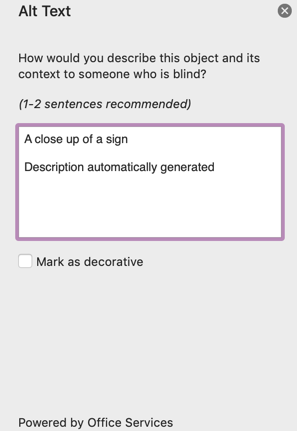
When I select this option, I can see the ability to add the alt text. If I have Microsoft Intelligent Services enabled – it’ll even have a go at filling it in for me. I also have the option to make the image as decorative. Awesome!
When I head to the review ribbon, I’ll see the Accessibility Checker has a prominent place. It’s right alongside the Spelling & Grammar checker, Read Aloud and the Translate option. It normalises checking for accessibility. Again, this is awesome!!!
So now I get to my point. Microsoft has been pretty ‘awesome’ at making accessibility a prominent, normalised feature. Now let’s look at Adobe InDesign – a piece of ‘industry standard’ software that is used for thousands of posters, books and resources. Now I know this software is for ‘professional’, users, but why do they need to bury accessibility?
For example, to add alt text, you need to choose ‘Object Export Options…’
This is not clear. No one would think to click on ‘Object Export Options’ to get to alt text. You then get this less thank helpful dialogue:
This is nowhere near as clear as the options in Word. What’s worse, is adding the text is not enough. There are a series of options and tick boxes that need to be selected, and the document needs exporting in just the right way. If all this is done correctly, it is highly accessible. However – it is not easy. If we want to encourage designers to make stuff accessible, those options need to be accessible too!
I am not criticising Adobe for their features. InDesign is powerful, and has *everything* you need to make a document accessible. However – all of these features are buried. In the current social climate, this should be a lot easier and a lot more prominent.
In short, Microsoft one, Adobe nil on this one! Once again – not because of the options in the program, but because of how easy and prominent they are to use. It simply sends the wrong message!
I’m at a Northern Collaboration learning exchange at the University of Sheffield. Here is my mindmap of the final session by Angie Greenwood from the University of Sheffield:
I’m at a Northern Collaboration learning exchange at the University of Sheffield. Here is my mindmap of the second session by Clare Miller from University of Durham:
I’m at a Northern Collaboration learning exchange at the University of Sheffield. Here is my mindmap of the first session by Fiona Rhodes from Lancaster University Library:





Recent Comments