The Double Diamond: Fixing Higher Education Challenges with Human-centered Design

Over the last couple of months, I’ve been part of a project to use human-centred design processes to approach challenges in Higher Education (HE). This was a big project, looking at institution-wide challenges and what could be developed to address them. We gathered volunteers across the University and asked them to work with us on identifying problems or challenges. We then considered what success looks like outside of HE and what solutions are needed in HE. Finally, we developed prototype solutions to identify how those issues could be addressed. These processes are primarily based on The Design Council’s (2019) Double Diamond (see below). The Double Diamond is a visual representation of the design process and is used to help ensure projects design the right thing and design things right (Ball, 2019).

The Double Diamond

Working through the Double Diamond leads you through two sets of divergent thinking to dream big – before using two sets of convergent thinking to bring back towards the issue at hand. This avoids the tendency for projects to identify one solution and fudge it until it works. Thinking through the Double Diamond puts people first, allowing a human-centred approach to design. The first diamond works towards identifying a design brief, while the second diamond develops and pilots solutions that eventually support an outcome. It can be argued that this is the heart of the design process.

The Double Diamond - two sets of divergent and convergent thinking.

These Double Diamonds of divergent and convergent thinking represent the four stages of design: discovery, define, develop and then deliver. These Double Diamonds sit between the challenge and the solution, leading teams from the problem to the outcome.

Discover

Discover focuses on questioning the problem or challenge. This focuses on dreaming big with the use of divergent thinking. Here, ideas can absolutely run wild – often, the crazier, the better. In our own project, one team developed a substantial monorail system to link the University to local communities. While we’re not going to build a monorail – it is a fantastic synonym of a wider problem. This all leads to the next stage: define.

Define

The second phase takes the findings of the discover phase and uses convergent thinking to synthesise and make sense of them. The end goal is a design brief that summarises and defines the problem. This clearly identifies the challenges and is used in the second diamond to work towards solutions. Using the monorail example led to a cohesive and condensed design brief that identified a challenge with connection and transport.

This phase can also identify further challenges that may link back to further discovery phases.

Develop

The third phase takes the design briefs and develops multiple solutions for them. This is another phase of divergent thinking, allowing that big-dreaming – but within the scope of the brief. At this phase, the different solutions will be prototyped and tested. This doesn’t have to be a real-world trial – but can involve mapping the solution and testing it with colleagues and service users.

Deliver

The final phase of the double diamond works to deliver the outcome. This phase uses convergent thinking to take one of the solutions forwards. This will eventually become the launched solution to whatever problems, issues or challenges have been identified.

This phase can identify the need for alternative solutions that link back to further phases of development. It can also redirect back to the very start if it identifies other challenges that require the full process again. As such, the Double Diamond can be cyclical, re-directing back to earlier phases where required.

From challenge to outcome with The Double Diamond

The below diagram brings together the phases discussed above. While there are multiple representations of The Double Diamond (Ball, 2019), you will notice they are all based on the principles written above. I’ve kept this visual simple, documenting the core steps and links forwards/back.

This diagram shows the Double Diamond. Phase one works toward a design brief, using a divergent discovery process followed by a convergent define process. The second phase uses a divergent develop process followed by a convergent deliver process to develop a solution.

Conclusion: Using The Double Diamond in Higher Education

The Double Diamond processes worked perfectly for our project. This was something that was largely linked to our digital and physical estate – but I am interested to see how this can be used elsewhere in our institution. These processes put people first – and there is significant potential for expanding this. I’m particularly interested in how this could support curriculum design. Our institution uses some excellent curriculum design frameworks, but this often misses that broader discovery phase. Programme teams may look at similar programmes of study, but we rarely go beyond. For me, the crux of the potential is this:

How often do we ask ‘What does an excellent educational experience look like?’ – thinking beyond the confines of Higher Education or our existing programmes of study.

This would allow us to look to schools, colleges, apprenticeships, coaches, training companies, MOOC providers and all other forms of education to learn from them. As a school governor, I often see excellent things happening in Primary and Secondary education that we could learn from. These experiences are had by our students in their early forms of education – and I often think HE isn’t ready to meet the expectations these set. Part of the problem is that programme teams are not responsible for the broader educational facilities and experiences that require development to meet some of these challenges. This would require a different mode of whole-university support for programme design, requiring different management forms, development and financial accounting.


References

Ball, J. (2019) The Double Diamond: A universally accepted depiction of the design process. Design Council. Available online: https://www.designcouncil.org.uk/our-work/news-opinion/double-diamond-universally-accepted-depiction-design-process [Accessed 20/08/2022]

The Design Council (2019) Framework for Innovation: Design Council’s evolved Double Diamond. Design Council. Available online: https://www.designcouncil.org.uk/our-work/skills-learning/tools-frameworks/framework-for-innovation-design-councils-evolved-double-diamond/ [Accessed 20/08/2022]

LEGO Serious Play starter kit for research & teaching

LEGO Serious Play was an essential aspect of my research method, getting participants to ‘build’ their answer, not just talk it through. I’ve also used it as a teaching facilitation tool to support critical and divergent thinking. LEGO is one of my most favourite research and teaching methods, as you can let people work through answers with the use of LEGO, and then capture the salient points when they share their build. It not only saves a lot of data processing for the researcher, but it is a lot more fun for participants. For teaching, it supports different forms of thinking and really gets ALL students involved. While LEGO Serious Play is a distinct facilitation approach and you can get trained to use it, there are also some helpful books to get you started. I recommend Blair and Rillo’s SERIOUSWORK as a good place to start.

To use LEGO for any aspect of research or teaching, you first need to buy some! This blog highlights the choices I made to build my budget LEGO Serious Play kit.

LEGO Serious Play sets are awesome! But expensive. There is a range of sets available on the official LEGO shop, but they were beyond my budget as a self-funded doctoral student. I had to improvise. This article will introduce the sets I purchased and how I think they worked for research and teaching use.

My haul

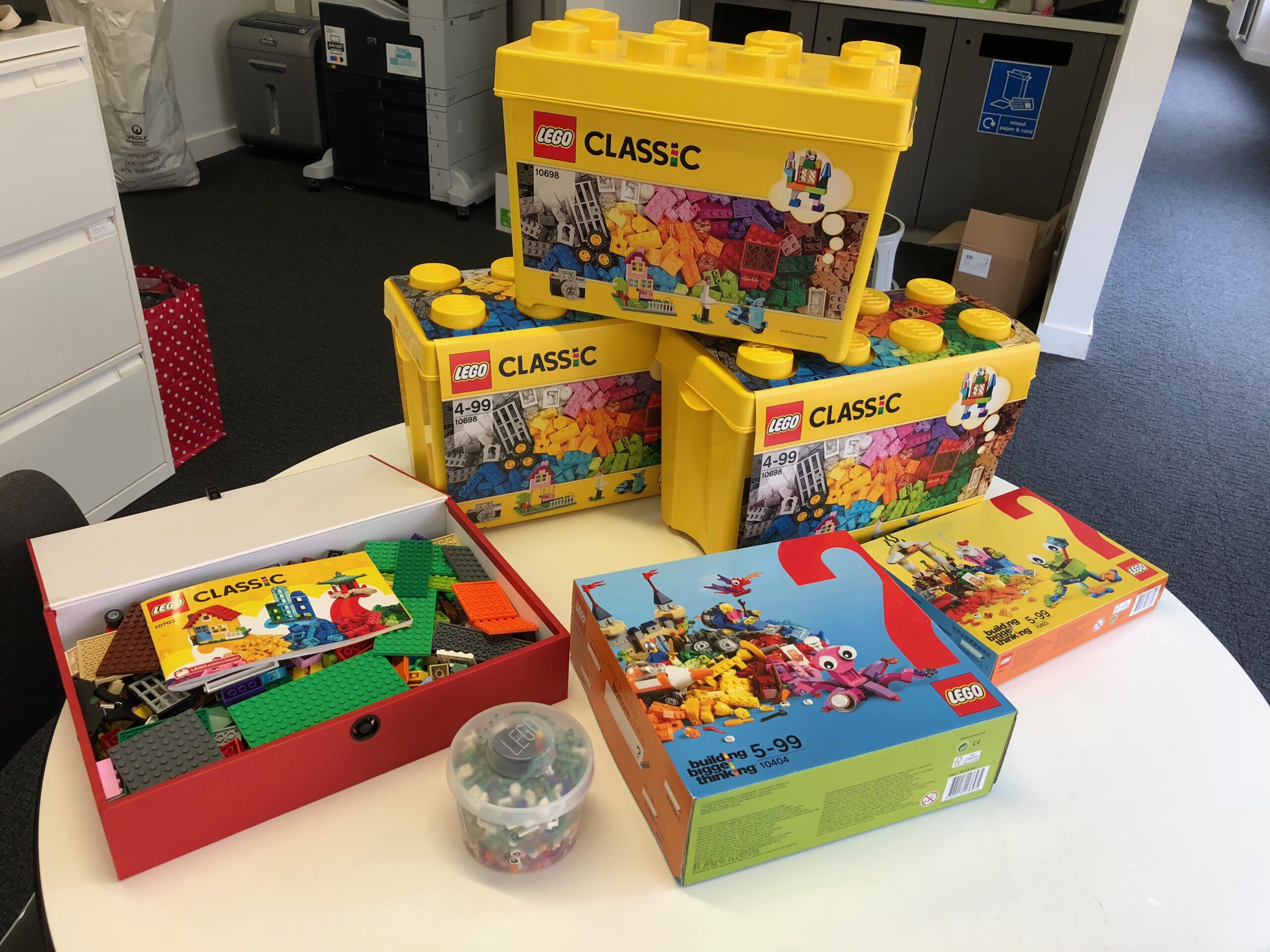
The LEGO sets I purchased for my LEGO Serious Play kit

LEGO classic

LEGO Classic sets are a brilliant way to bulk out your LEGO Serious Play kit. You get a lot of brick for your money, and the variety of colours is fantastic. I’m so jealous of children today – LEGO had about five colours when I was a child. I already had a Large Creative Brick Box (10698) – so bought a couple more to serve as the baseline of my LEGO Serious Play kit. The plastic storage boxes they come in are also the perfect place to keep the LEGO stored away between uses. In addition to these larger sets, I also bought a couple more classic sets, one featuring lots of windows and doors (11004) – the other featuring lots of wheels (11014).

The available sets vary over time, but I have found they usually have a classic set on offer with extra wheels and another with windows and doors. These are useful additions to any LEGO Serious Play kit so I’d advise investing in such sets. Windows and doors are not only useful in a literal sense, but they work well for metaphors. Wheels work well for movement, vehicles and more. I’ve also seen a set with extra roof tiles which I think could be useful. It’ll certainly be part of my next LEGO purchase.

Interesting bricks

Next up I wanted to add a set with some different/interesting bricks. To be honest, any set would do for this – but I wanted to avoid anything licenced. I felt items like a Star Wars brick or a Spiderman Minifigure would not serve as universal references, so wanted to avoid them. I think Minecraft LEGO sets are particularly useful as they have lots of transparent tiles and colourful bricks. At the time I purchased my kit, LEGO was celebrating its 60 year anniversary and had launched some special Building Bigger Thinking sets. I purchased World Fun (10403), which contained some useful pieces like a treasure chest, eyes, columns, helicopter and a couple of Minifigures. I also chose Ocean’s Bottom (10404) which has more eyes, wings, wheels and transparent bricks.

All these LEGO classic sets built the bulk of my LEGO Serious Play kit. This gave me lots of standard bricks, including windows, doors, wheels and more. The next pieces I used to build my collection were all a matter of choice. For example, baseplates can be useful for a lot of LEGO Serious Play kits – but they were not something I needed for my particular research. As such, I decided to forego them. If you need to facilitate collaborative builds then baseplates are the perfect way to bring this together.

Pick a Brick

To top off my LEGO Serious Play kit, I wanted to choose a few additional bricks. To help with this, I used the Pick a Brick station at a LEGO store. I focused on extra eyes, small tile pieces and anything else small. This would allow participants to build intricate/small/detailed models – should they wish.

Minifigures

Minifigures can be a bit of a divisive topic when considering their use in LEGO Serious Play. They can lead participants to focus on people (which may not be a bad thing) when they’re building their answers. For my research, I felt participants would benefit from Minifigures. Libraries are inherently social spaces – and people are part of that. I didn’t want participants wasting time in my research sessions ‘building people’ – so Minifigures it was!

Again, I felt the best place to get these was through a LEGO shop. There are build-a-Minifigure stations in LEGO shops allowing you to build three custom figures per pack. Four packs (12 figures) covered my needs.

Preparing the LEGO

The worst thing you can do is walk into your first LEGO Serious Play research or teaching session with a load of new boxes of LEGO. It’s worth spending some time unboxing and unbagging it to ensure it is ready to use. I also spent time assembling a few elements to make them ready for use. For example, adding tyres to wheels, putting wheels on axels, putting panes in windows and adding doors to their frames. While participants are free to switch things around, it does mean the bricks are ready for use without needing to combine these pieces.

From the unboxing photo below, you can see there was a lot of plastic bags to ditch. I also wanted to find a way to layout the LEGO without getting it everywhere – so I used the cardboard box lids from printer paper boxes. It worked really well to stop LEGO falling all over the floor during my research sessions.

Ready to go!

With all the LEGO purchased, unpacked and ready to go, I was able to start using it for teaching and research purposes. I still keep the LEGO stored in the big yellow boxes that came with the larger sets. I also bring a load of those empty box lids to pour LEGO out and stop it from getting everywhere.

LEGO works as a wonderful research and educational tool. I took this snap from one of the first sessions I facilitated three years ago. I can’t wait to share some more of my reflections on this.

LEGO, the LEGO logo, and the Minifigure are trademarks and copyrights of the LEGO Group. ©2021 The LEGO Group.

‘Normal’ or ‘New normal’ —Reflections on getting back into in-person teaching

Written on a train on a phone – so forgive any typos. I’ll tidy up later!

Since 18th March last year (2020), all of my teaching has been online. Obviously, this was the right thing to do. Society closed. We didn’t really know much about the novel coronavirus first identified in 2019, we didn’t know much about transmission and vaccines were still a dream. The situation also developed rapidly. The government told us not to be worried about the virus, that it was of little concern. Two weeks later, we were in lockdown. For everyone in higher education, this led to a monumental pivot online. Like every university, Hull responded and followed governmental guidelines.

When the lockdown hit, I felt lucky to be based in the Skills Team at the University of Hull. As a team, we all had experience of teaching online. We also had the software, the tools and training to deliver a good online experience. Nothing needed to be procured. No training was needed. We just picked up and got on with things. I’m not saying that the switch to online teaching wasn’t challenging — but we had somewhat of a head start.

As the pandemic evolved over summer 2020 and cases plummeted, we were able to open our library — the Brynmor Jones. This was done with an abundance of caution, following all safety guidance and with a lot of risk assessing. We were one of the first HE libraries to re-open, recognising not all of our students had access to the technology or connection they required to be successful at home. The library formed an important part of social and cultural capital for some students — helping provide what they may not readily have. While open, as a library we also focused on safety, still delivering our support digitally. This meant that our service points were not staffed in the same way and we focused on self-help, live chat and query management. The library was primarily open for socially-distanced study.

While the library was open, teaching and appointments we’re still off the agenda. At the point of initial opening, we still kept these online. This doesn’t mean I’ve been working from home all this time. As soon as the Library re-opened last year, I was in the occasional day, usually once a week. I figured that if our frontline staff were in – I should show face too. I eased myself in. By January 2021, I committed to three days a week.

For most of the year, while I was on campus, my students weren’t. All classes will still online. In May 2021, we were able to offer face-to-face appointments again. It was strange (but lovely!) to see students again. I felt connected to my work again. It reminded me why I love my job — I’d missed that interaction more than I realised. While appointments slowly ticked over, class-based teaching, workshops and lectures face-to-face were still some time away. At this point, it meant that while none of us stopped teaching, many lecturers hadn’t ‘lectured’ or taught on campus for over a year. That’s a long time!

My timeline now lands on last week. The 6th September. My first on-campus teaching for over a year and a half.

I was a bit nervous. Not going to lie.

Was teaching in a room like ‘riding a bike?’. That is to say — can I easily pick it up again despite all this time away? As I walked over to the Cohen building, the nerves melted away to make rookie excitement. I was so excited I took a selfie to make the occasion – but decided to do this outside the building so the students didn’t think I was odd before I even started teaching them.

Yup! Me stood outside Cohen.

A quick photo later, I found myself stood in a room much larger than needed to facilitate some social distancing, I looked over a sea of faces (well… 25 faces), and I began to teach.

Thankfully. It was like riding a bike. I just fell back into that comfortable space at the front.

It struck me how odd it was being able to move and use body language again. It was surreal! I didn’t realise how limiting a webcam could be until I was freed from those constraints. I could gesture. I could easily point to my slide visuals. I wasn’t trapped behind a screen. Teaching in-person went beyond this freedom. It was easier — and I hope — better!

I was in the middle of explaining a model of criticality, and my students looked puzzled. I’d not explained it effectively. I’d lost some of the room. Immediately — I was able to change track and reframe my explanation. I could see the metaphorical lightbulbs switch on. They’d understood what I said. I’d explained better. I have missed that more than anything with online teaching. The tendency for students to not turn on webcams removes this valuable tool from educators. We can’t see how our students are doing. This, more than anything, I had missed.

It isn’t just about understanding or not. There are other visual queues to respond too. There were some clear points at which I could see students were a bit overwhelmed, worried or even frightened of the expectations ahead. However, in seeing this, I was also able to reassure them that we would support them to get there. They have a wall to climb, but we’ll help them build a ladder.

My final reflection focuses on energy. I’m well used to being on campus with my regular three days now part of my schedule. I had previously found it a tiring transition when I first adjusted from vegetating at home to being in the office. But I was past that. At least the main hit. Teaching, however, did exhaust me more than I expected. It takes a lot of physical energy. Standing, gesturing, thinking, watching, projecting my voice — as much as I loved my first session, I was sure tired after!!!

My advice to anyone easing back into campus is to be prepared. Getting out of the home for working is tiring. It’s an even bigger hit when you throw in some lectures.

The development of university teachers vs. the learning developer

Today I had the pleasure of starting my Postgraduate Certificate in Academic Practice (PCAP). As a learning developer, my journey is atypical to the peers on my course. This article serves as my first reflection about this. Our first reading was Kugel’s (2006) How professors develop as teachers. Kugel discusses a typical development pathway for lecturers — moving from an understanding of how to teach students towards an understanding of how to support their learning. In this, there are six stages, each characterised by the changing focus as lecturers develop their practice:

The transition from teaching to learning

This model was interesting. Kugel discussed how new teachers tend to focus on themselves as they begin to teach. They move towards solidifying their own discipline knowledge before starting to take into account students. These initial changes focus on teaching. The understanding of students develops, acknowledging them as receptive, then active learners. These later stages begin to focus on learning above teaching. Finally there is an understanding of learners as independent — with the core role of the teaching being to support students to teach themselves.

While I can see much in this model, it’s an interesting reflection for me as a learning developer.

The primary role of a learning developer is to help learners achieve that end goal — independence. While there are many nuances to this, ultimately learning developers are aim to work with students to help them develop their own autonomy and self-sufficiency. So… do learning developers really jump to the final stage of Kugel’s model?

Perhaps. At least at first. As a new practitioner starting in the learning development field 9 years ago, I feel I started from day 1 as a practitioner supporting this goal. Perhaps somewhat light in the tools I had at my disposal – but a focus on independent learning all the same. What I didn’t realise was that learning development itself had an underlying literature I needed to understand. As such, I perhaps worked backwards through some of Kugel’s model. I had to back-step and develop myself and my disciplinary knowledge to ultimately make me better at supporting that learning.

That backwards learning was important. It made me appreciate the diverse ways in which most academic tasks can be achieved. Without this understanding, there can be a focus on promoting your practices — or at least a narrow range. Inclusive higher education practices should never aim to reproduce yourself. More importantly, it required me to understand what teaching means, and how in reality, it wasn’t really that important in most learning development encounters. Indeed, it wasn’t even something I did that much. That brings me to my last reflection on this paper.

This final reflection relates to ‘teaching’ itself. The paper focused on teaching alone. However, as educations, we have more tools than teaching alone. As learning developers we are coaches. We are mentors. We are cheerleaders – and yes! Sometimes teachers. Yet, teaching isn’t everything. It is just part of the story.

Learning development and student narratives – Professor Shân Wareing

Professor Shân Wareing delivered an incredibly relevant and interesting keynote today at the Association for Learning Development in Higher Education (ALDinHE) Conference. Here are my notes (in mindmap format) from this session, which include elements of the discussion and wider definitions:

See link below for accessible, linear download

The University Library Emerges

Britain’s two oldest universities prove good examples of the first university libraries. The University of Oxford’s first library emerged in 1320 as part of the University Church of St. Mary the Virgin (Bodleian Libraries, 2016). This continues to represent the link between early academic libraries and religion as discussed above. It was not until 1488 that this was replaced with the Duke Humfrey’s  Library and even then, it was housed in the second storey of the Divinity School (Pugh, 2000). This library was named after the Duke for his generous donation of 281 manuscripts (Summit, 2008; Bodleian Libraries, 2016). This early academic library was not the most hospitable place. The room was poorly lit, functionally furnished and all of the books were secured with chains (Pugh, 2000). What follows is a reflection on such spaces and what they would be like to study in.

The lone scholar sat on a hard bench in the poorly lit room. He was using one of the lecterns which were all set at a right angle to the windows. The light this provided varied with the sun and once again he found himself straining to see the hand-written pages in the dim light. The library was not heated so the cold had begun to sink into his aching bones. The uncomfortable furniture of the library was not helping the matter.

He was studying from a large manuscript that was, like all other materials firmly chained to the desk. This was of course to ensure the books were kept save but would not allow him to move the volume to somewhere with more light. He should not complain. No, he would not complain. Access to these precious leather-bound volumes was a real privilege, a luxury courtesy of his membership of the university. Still, it was with some surprise that he realised he was still the only student in the room. The same as the previous day.

While the library presented a valuable resource, it was not the most welcoming place. In fact to anyone not interested in the collection this library was awful. No natural light. No heating. The constant vigilance from the scholars charged with the protection of the books. Everything was make of hard, dark wood and nothing was comfortable. This was not a space that was used by many.

Based on (Pugh, 2000; Bodleian Libraries, 2016)

Duke Humfrey’s Library only lasted 60 years and was purged in 1550 as part of the attempt to clear the English church of all references to Catholicism, it was rescued in 1598 by and offer from Thomas Bodley (Bodleian Libraries, 2016). He pledged to refurbish the university library and procure books for it (Philip, 1983; Pugh, 2000). This was amid the rise of libraries across Europe, with some scholars arguing that this was the “age of the libraries” as it was at this point the focus moved form library as collection to the library as a specific space (Summit, 2008:11). Unsurprisingly Bodley’s offer was quickly accepted by the Vice-Chancellor of the university (Philip, 1983).

Roman Kirillov (CC BY-SA 3.0) – WikiCommons

Bodley’s refurbishments made to the library included the installation of new shelves, chains and locks, with the work completed by mid-1600 (Philip, 1983), enabling Bodley to focus on procurement of books. Much of the initial collection resulted from donations of money and books, demonstrating the importance of philanthropy in the development of such libraries.  The new library opened in 1602 (Bodleian Libraries, 2016; Taylor et al., 2016). To assert the importance of preservation, this new library required readers to take the following ‘Bodleian oath’ before being allowed access:

“You promise and solemnly engage before God… that whenever you shall enter the public library of the University, you will frame your mind to study in modesty and silent, you will use the books and other furniture in such manner that they may last as long as possible. Also that you will [not] steal, change, make erasures, deform, tear, cut, write notes in, interline, wilfully spoilt, obliterate, defile, or in any other way retrench, ill-use, wear away or deteriorate and book or books, nor authorised any other person to do the like.”  (Clapinson, 2006 reproduced in Pettegree, 2015:80-81)

This oath is an interesting insight into the importance of preservation. Over twelve words are used to identify every possible form of damage a book could undertake to ensure the reader swears against it and a version of this oath is still in use today (Goodall & Britten, 2012).  Pettegree (2015) notes that previously, libraries had been places for discussion and it was this oath that introduced the new emphasis on silence. According to Pettegree (2015: 81) it is here that the “long decent into silence” began.

Since then the library has developed over subsequent years, spanning several buildings/libraries, becoming a library of legal deposit and an internationally regarded institution (Bodleian Libraries, 2016). Gained in 1610, the status of legal deposit allowed the library to receive any published volume in the United Kingdom that it requests and this status remains today (Bodleian Libraries, 2016; British Library, 2017).

There is a similar story at the University of Cambridge University of Cambridge (2016), where in the 1300s the university stored its books in chests within the university treasury, with the university building its first library around 1410. Similar to Oxford, Cambridge suffered book purges, but later grew from strength to strength, becoming a library of legal deposit and world renowned library (University of Cambridge, 2016). For both libraries, this growth was slow, especially as heating and artificial lighting were not widely available until 1800-1900.

The problems and purges of the sixteenth century were more troublesome than the brief history above suggests. First, the growth of printed books allowed scholars to easily create their own up-to-date collections of books, often more relevant that the books donated to the university libraries (Pettegree, 2015). The greater challenge perhaps was reflected in the purges hinted at above. As the conflicts between Catholicism and Evangelicals grew, library spaces found the themselves subject to the will of whichever faction was in power (Pettegree, 2015). This led to regular searches for anything deemed heretical or forbidden so such materials could be destroyed. This led to the eventual closures of both libraries in the middle of the sixteenth century, even including the disposal of the books and furniture at Oxford.

Academic libraries have a 700-year history due to these universities and this very brief history has demonstrated that crisis, redevelopment and reconceptualization is something libraries have had to deal with for hundreds of years. It is important however to reflect on what these libraries were like as spaces. There is some evidence that suggests the library customs of Oxford and Cambridge Universities directly followed monastic customs (Mullinger, 1907-21). This would in particular regard the preservation of books and their protections. As suggested in the histories above, as spaces they were not particular hospitable. The early libraries of these two universities defined the very first academic libraries.


Bibliography

Bodleian Libraries (2016) History of the Bodleian. Available online: https://www.bodleian.ox.ac.uk/bodley/about-us/history [Accessed 14/04/2016].

British Library (2017) Introduction to Legal Deposit. Available online: http://www.bl.uk/aboutus/legaldeposit/introduction/ [Accessed.

Goodall, H. & Britten, N. (2012) Bodleian Library considers lending books after 410 years, Telegraph.2012 [Online]. Available online: http://www.telegraph.co.uk/education/educationnews/9327429/Bodleian-Library-considers-lending-books-after-410-years.html, [Accessed 15/06/2017].

Mullinger, J. B. (1907-21) The Foundation of Libraries, in Ward, A. W. & Waller, A. R. (eds), English Prose And Poetry Sir Thomas North To Michael Drayton. The Cambridge History Of English And American Literature. Cambridge: Cambridge University Press.

Pettegree, A. (2015) The Renaissance Library and the Challenge of Print, in Crawford, A. (ed), The Meaning of the Library: A Cultural History. Princeton, New Jersey: Princeton University Press, 72-90.

Philip, I. (1983) The Bodleian Library in the Seventeenth and Eighteenth Centuries. Oxford: Clarendon Press.

Pugh, S. (2000) The Problem of Light in Duke Humfrey’s Library. The Paper Conservator, 24(1), 13-25.

Summit, J. (2008) Memory`s Library: Medieval Books in Early Modern EnglandUniversity Of Chicago Press.

Taylor, S., Whitfield, M. & Barson, S. (2016) The English Public Library 1850-1939. Available online: https://content.historicengland.org.uk/images-books/publications/iha-english-public-library-1850-1939/heag135-the-english-public-library-1850-1939-iha.pdf/ [Accessed 14/04/2017].

University of Cambridge (2016) History of Cambridge University Library. Available online: http://www.lib.cam.ac.uk/about-library/history-cambridge-university-library [Accessed 14/04/2017].

Attending an online conference: The ALT Winter Conference 2017

This week I had the pleasure of attending the Association of Learning Technology (ALT) Winter Conference. This free conference was entirely online, delivered via a series of parallel sessions. Webinars, Twitter chats and wildcard sessions formed the basis for these sessions, with a good mixture of each across both days. It was my first time taking part in an online conference and so I wanted to reflect on the format here. Technologically, I thought BlackBoard Collaborate Ultra served for the webinars very well and it was nice to experience this first hand. I usually use Adobe Connect in my own practice so it’s always nice to see another system working.

The first thing that is important to note is that I attended from my open plan office at work. This of course makes a difference as I was surrounded by colleagues, and I was fitting conference sessions in alongside other work commitments. This means I wasn’t fully dedicating all my time to the event, which is a very different experience to being at an actual conference where you are fully immersed. This had advantages and disadvantages. On the positive side, I was able to take part in the first place. I simply would not of had the time or money to travel to any conference at this time of year. On the negative, I felt it was not as good a networking opportunity as face:face conferences, and, that it did not provide the same ring fenced development time that you get with being away.

It would be unfair to say networking opportunities were absent. Dialogue and interactivity was present in every parallel session. There was also the #altc hashtag on Twitter for the backchannel conversation throughout both days. However, this is no different to the opportunities afforded at any conference. What I really missed however were the little conversations after sessions, in traveling, between parallels, over coffee, throughout lunch, at evening events and through drinks. I find a lot of the benefit of traditional conferences can be found around the formal programme, not just within it. I should note, the conference did have an always-on cafe for conversation. It was just empty the couple of times I tried to visit. Perhaps Twitter was the better forum?

Pacing the conference around work activities was fairly easy, and I imagine I was not the only person doing this. This did mean some times of day were perhaps busier than others, but this could have been depended on the sessions. The only frustrating thing about attending remotely is the clash between a very useful parallel and a work activity. Of course the work activity takes precedence! It just always tends to coincide alongside the one session you really wanted to see.

The aspect of time away is a difficult one. One of the things I like about a traditional conference is the mental break you get. The time away. The opportunity to focus on self-development, learning, thinking, networking, idea sharing, collaborating and more. The day job, research, writing or whatever else you are doing is placed on hold. Not forgotten, but you put yourself in a different space away. I’m not saying this is absent in an online conference, but because there is a tendency to take part from home or work, it is not the same kind of break. As above, this is advantageous as it means work does not need to stop for your to take part. But it prevents gains in some areas.

While I missed the face to face elements, I think this kind of conference is a fantastic opportunity. As I stated above, I would not have been able to take part were this a traditional conference. I also liked that I did not have to dedicate two whole days and travel to this. While I would usually gladly do this for any conference; work, my research, volunteering and general life are too busy to take all that time out! I’d like to extend a thanks to anyone running a session I attended at the conference. They were all engaging and I look forward to enacting some of this stuff in practice. Huge thanks to ALT too for putting it all together and making it possible.

Maybe I should also celebrate the fact an online conference helped me avoid a few wet days!

The bitesized EdD: Finding slots of time for a professional doctorate

Over the last few weeks I’ve been able to find more time for EdD writing (and reading). This hasn’t been large chunks of time, but just making better use of the small pieces of time I would usually waste.

It is easy to fall into the trap of feeling a doctorate needs whole days and afternoons of time. Yes. This helps. But actually, small bits of time really add up. Finding a couple of fifteen or twenty minute windows per day easily leads to a few hours over the week. This is where I’m finding my time.

I’ve been able to get a good twenty minutes on a fair few mornings to squeeze in some work. Instead of waiting for weekends or a whole free evening, I’ve found additional EdD time by squeezing in an extra hour or two on a few week nights. This hasn’t really impacted my personal life as I’ve fit this in after my fiancé goes to bed.

Being able to pick up work in small chunks like this requires a lot of discipline. It’s hard to put the work down after a few minutes. But when you have only twenty minutes – that is what you have to do! It also means you need to jump into productivity quickly and get yourself used to picking up where you left off quickly. This also requires discipline and practice.

I find technology really helps with this. Microsoft Word handily tells me where I left off. One Drive allows me to pick up work on any Mac, computer or iPad tablet. OneNote keeps my notes available everywhere. EndNote lets me take my library with me. All of these tools together allow me to quickly pick up bits of work. Quite often, I find OneNote is the largest enabler. I can quickly pick up some reading and make some notes or record some thoughts.

Track changes and Microsoft Word comments are also a great way to keep up with where I left off. One thing I’ve yet to try is a recommendation for @JaxBartram, she recommended always ending mid sentence. The idea being it is always easier to pick up work mid-sentence than it is to start afresh.

One one way to see if that works!

Home Office